Can You Paint Galvanised Steel? A Step-by-Step Guide

Yes, you can paint galvanised steel, and it's a common, well-established thing to do: colour coding, matching an aesthetic, or adding an extra layer of protection in a harsh environment are all good reasons to do it. The catch is that painting galvanised steel isn't as simple as painting bare steel. New galvanising has a smooth, slightly greasy surface that ordinary paint struggles to grip, so skipping preparation is the single biggest cause of paint peeling, flaking or bubbling off a galvanised surface within months rather than years. Get the preparation and paint for galvanised steel right, though, and the finish will last as long as any other well-specified paint system.
Why Paint Galvanised Steel At All?

Galvanising on its own already gives steel decades of low-maintenance corrosion protection, so painting over it isn't usually done to stop rust from starting. According to the Galvanizers Association, people paint galvanised steel for three main reasons: to add colour for aesthetic, camouflage or safety purposes; to increase the economic life of a structure; and to provide extra protection in particularly aggressive environments, such as heavy industrial or coastal sites. Combining the two, paint over galvanising, is known as a duplex system, and because each layer protects the other in a different way, a well-prepared duplex system holds up for considerably longer than either paint or galvanising would on its own.

On site, this usually comes up in a handful of situations: colour-coding structural steelwork or handrails for safety or branding, matching galvanised fencing or gates to a wider colour scheme, or adding extra protection to steelwork on an exposed industrial or coastal site where plain zinc alone might weather faster than the project needs.


Do You Need to Prepare Galvanised Steel Before Painting?

In almost every case, yes. Fresh hot-dip galvanising comes off the zinc bath with a smooth, slightly oily surface and, often, mill contaminants that give ordinary paint nothing to key into. Painting galvanised steel without this step is the single most common reason a paint job fails early, peeling away in sheets rather than gradually wearing. There are a small number of specialist direct-to-galvanise paints formulated to skip this step, but they're the exception rather than the rule, and for most projects, proper surface preparation is what determines whether the paint job lasts five years or fifty.


How to Paint Galvanised Steel: Step by Step

Follow the five steps below in order rather than skipping ahead to the paint itself. Preparation is what most of the job actually rests on: get the cleaning and pre-treatment right and the primer and paint stages are straightforward, but rushing or reordering them is the most common way a good paint job goes wrong.


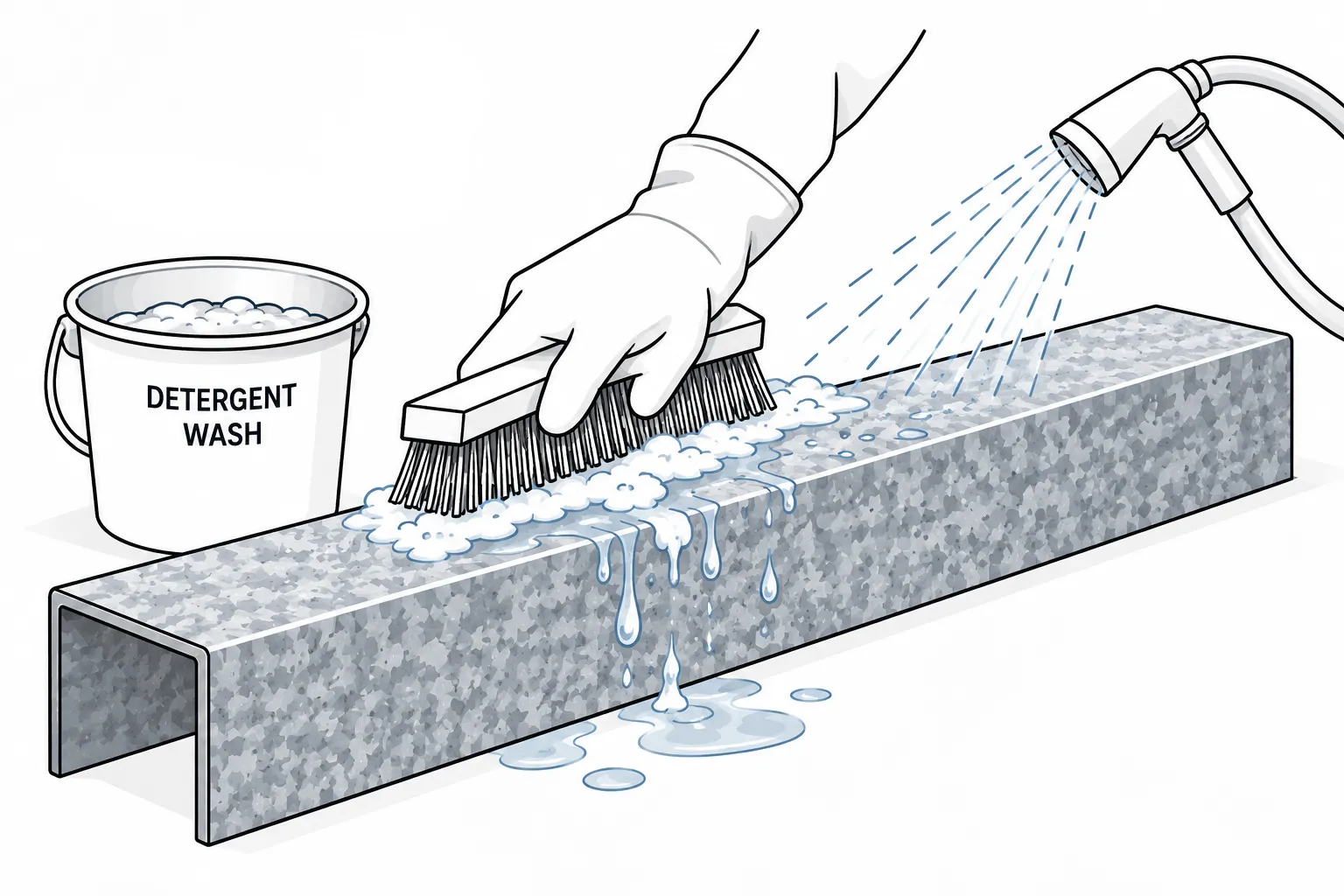
Step 1: Clean the Surface

Before anything else, remove all oil, grease and dirt from the galvanised surface, since even a light film will stop a pre-treatment or paint from bonding properly. Use a detergent wash rather than a solvent that could leave its own residue, and rinse thoroughly with clean water afterwards. If the steel has picked up wet storage staining, the white, powdery deposit that can form on galvanising stacked while damp, scrub it off with a stiff brush rather than painting over it. The surface needs to be fully dry before you move on to pre-treatment.

Step 1: Clean the Surface

Before anything else, remove all oil, grease and dirt from the galvanised surface, since even a light film will stop a pre-treatment or paint from bonding properly. Use a detergent wash rather than a solvent that could leave its own residue, and rinse thoroughly with clean water afterwards. If the steel has picked up wet storage staining, the white, powdery deposit that can form on galvanising stacked while damp, scrub it off with a stiff brush rather than painting over it. The surface needs to be fully dry before you move on to pre-treatment.


Step 2: Choose a Surface Pre-Treatment

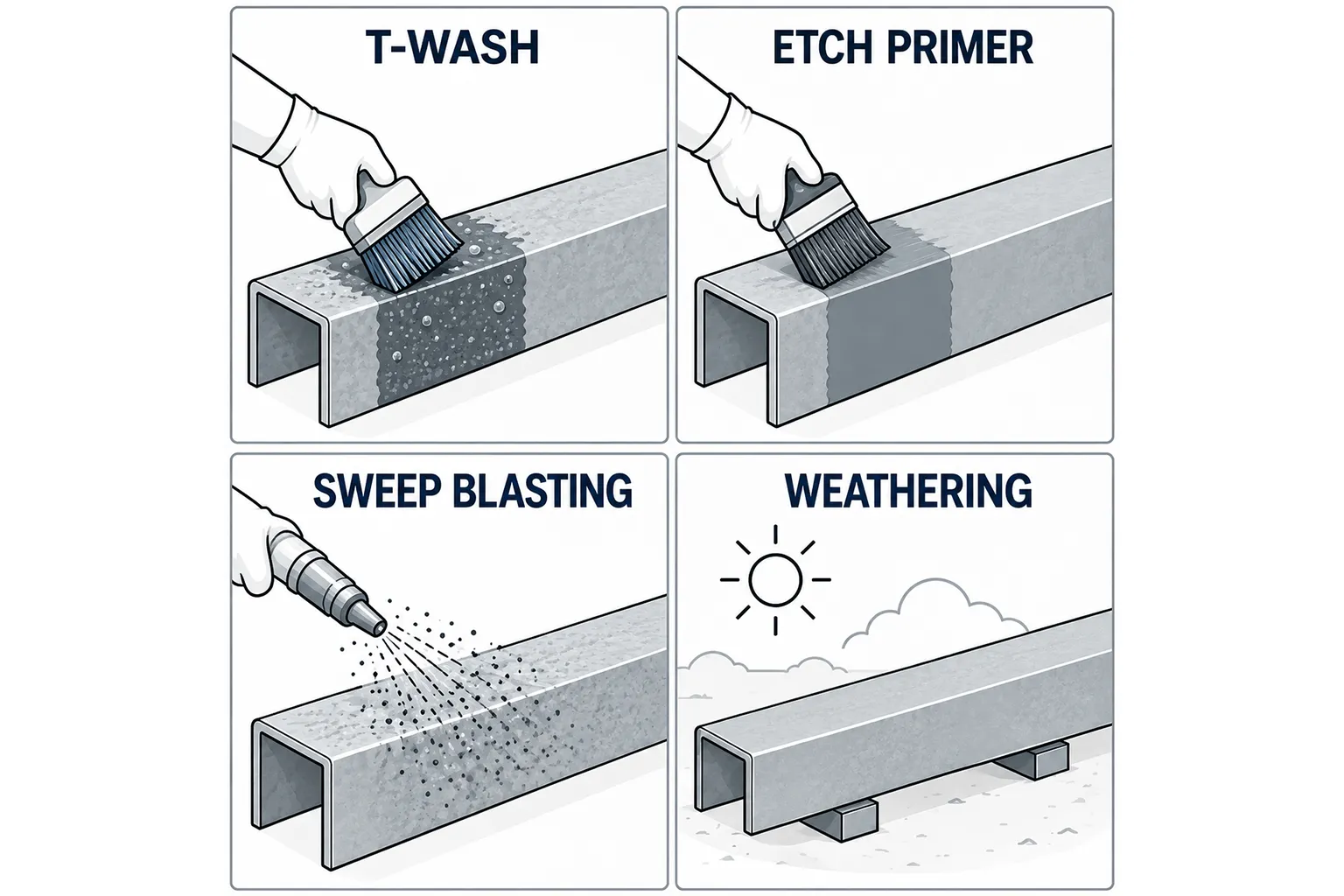
This is the step that decides whether the paint stays put. The Galvanizers Association recognises four established methods, and which one suits your project depends mainly on whether the steel is newly galvanised or has already been outdoors for a while.

T-Wash, or a proprietary equivalent, is generally considered the best option for new galvanising. It's a modified zinc phosphate solution that leaves a visible dark grey or black discolouration where it's reacted, so you can see exactly where it's worked. It needs time to dry thoroughly before painting, and shouldn't be used on galvanising that's already weathered.

Etch primers work in a similar way and suit older, weathered galvanising better than T-Wash, though without a colour change, there's less certainty every surface has reacted evenly.

Sweep blasting uses a fine abrasive, such as copper slag, at low pressure to lightly roughen the surface without stripping away the coating. It's often used alongside a chemical treatment rather than instead of one.

Weathering relies on at least six months of outdoor exposure to naturally dull the zinc surface before it's cleaned and painted. It's the slowest option and isn't suitable in marine or other high-chloride environments.

Step 2: Choose a Surface Pre-Treatment

This is the step that decides whether the paint stays put. The Galvanizers Association recognises four established methods, and which one suits your project depends mainly on whether the steel is newly galvanised or has already been outdoors for a while.

T-Wash, or a proprietary equivalent, is generally considered the best option for new galvanising. It's a modified zinc phosphate solution that leaves a visible dark grey or black discolouration where it's reacted, so you can see exactly where it's worked. It needs time to dry thoroughly before painting, and shouldn't be used on galvanising that's already weathered.

Etch primers work in a similar way and suit older, weathered galvanising better than T-Wash, though without a colour change, there's less certainty every surface has reacted evenly.

Sweep blasting uses a fine abrasive, such as copper slag, at low pressure to lightly roughen the surface without stripping away the coating. It's often used alongside a chemical treatment rather than instead of one.

Weathering relies on at least six months of outdoor exposure to naturally dull the zinc surface before it's cleaned and painted. It's the slowest option and isn't suitable in marine or other high-chloride environments.


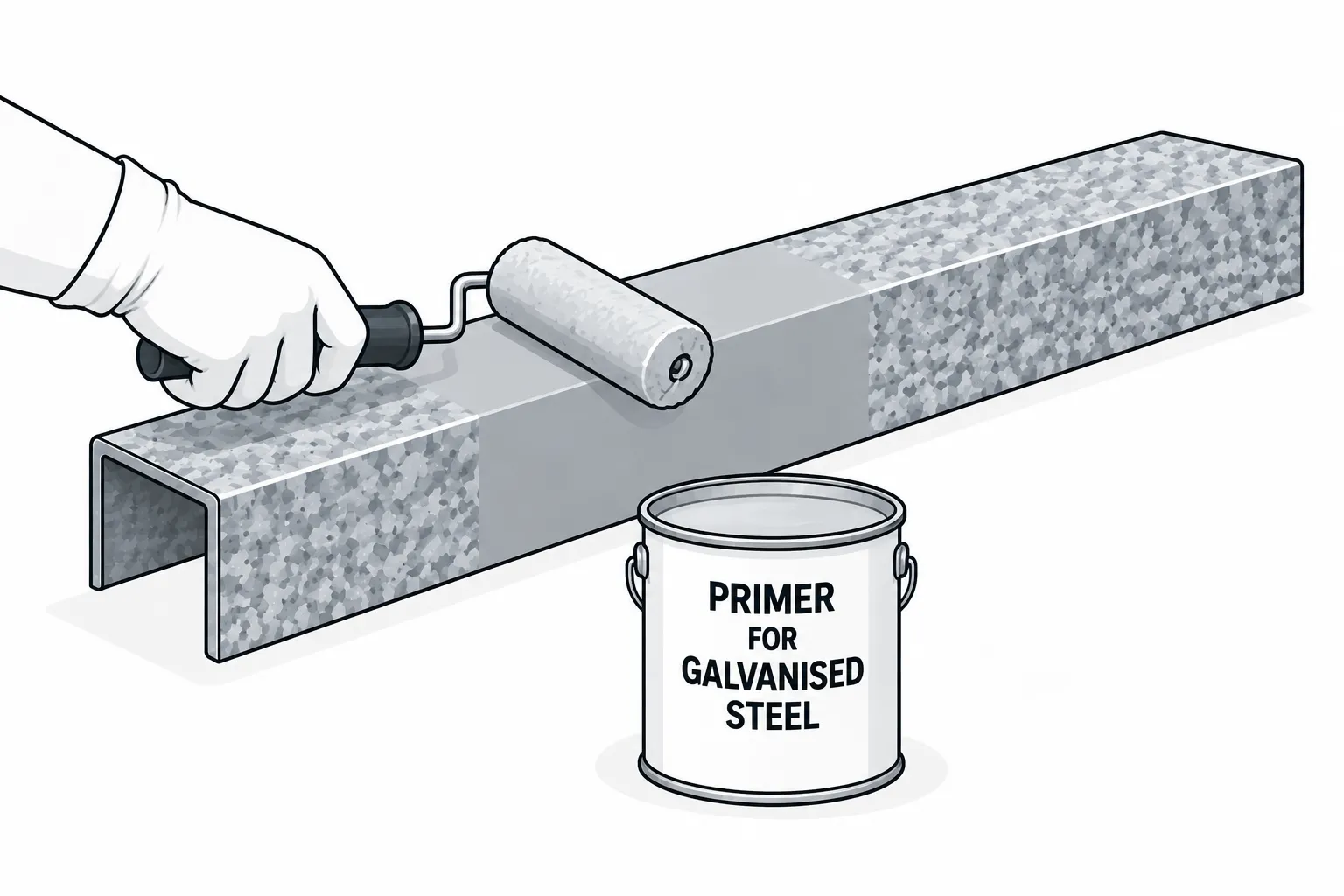
Step 3: Apply a Primer for Galvanised Steel, Where the System Calls for It

Some paint systems apply straight over a T-Wash or etch primer treated surface; others call for a dedicated primer coat first, often one containing micaceous iron oxide, which has been shown to improve adhesion in multi-coat systems. Check the paint manufacturer's system as a whole rather than assuming a general-purpose metal primer will do the job. A primer for galvanised steel needs to be formulated to work with zinc specifically, not just metal in general.

Step 3: Apply a Primer for Galvanised Steel, Where the System Calls for It

Some paint systems apply straight over a T-Wash or etch primer treated surface; others call for a dedicated primer coat first, often one containing micaceous iron oxide, which has been shown to improve adhesion in multi-coat systems. Check the paint manufacturer's system as a whole rather than assuming a general-purpose metal primer will do the job. A primer for galvanised steel needs to be formulated to work with zinc specifically, not just metal in general.


Step 4: Choose the Right Paint for Galvanised Steel

Whatever paint you use should be specifically formulated for galvanised steel, not just described as suitable for metal generally. High-build epoxy and vinyl or vinyl co-polymer systems are common choices, with glass-reinforced epoxy stepping in for more severe environments. For the top coat, two-pack polyurethane and acrylic urethane are widely used for their durability and colour retention, while polysiloxane finishes add extra resistance to abrasion. Always check the paint is compatible with whatever pre-treatment or primer sits underneath it, since manufacturer systems are designed to work together rather than be mixed and matched.

Step 4: Choose the Right Paint for Galvanised Steel

Whatever paint you use should be specifically formulated for galvanised steel, not just described as suitable for metal generally. High-build epoxy and vinyl or vinyl co-polymer systems are common choices, with glass-reinforced epoxy stepping in for more severe environments. For the top coat, two-pack polyurethane and acrylic urethane are widely used for their durability and colour retention, while polysiloxane finishes add extra resistance to abrasion. Always check the paint is compatible with whatever pre-treatment or primer sits underneath it, since manufacturer systems are designed to work together rather than be mixed and matched.


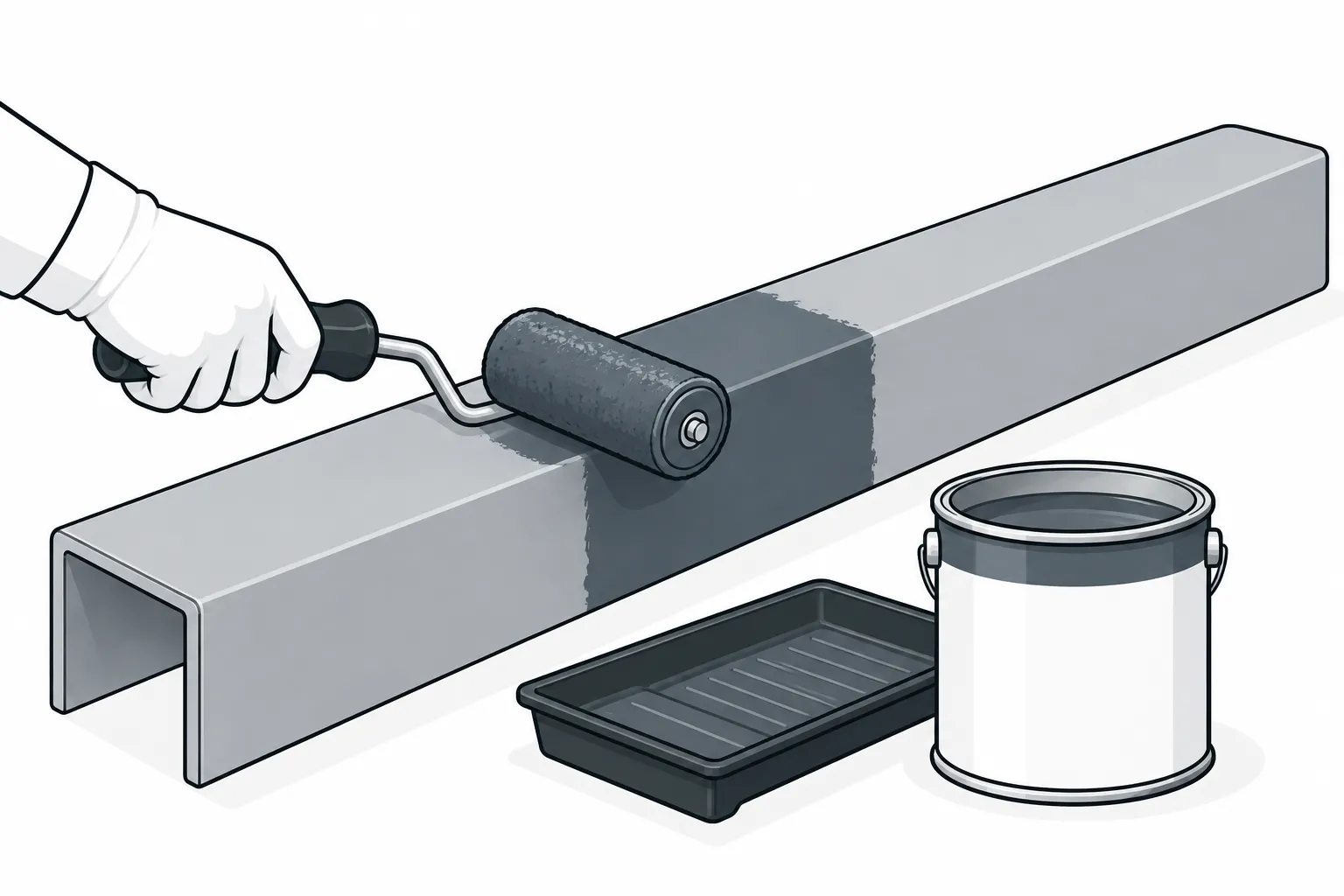
Step 5: Apply the Paint

Apply strictly to the manufacturer's instructions: the right ambient temperature and humidity, the correct dry film thickness, and the recommended time between coats. Most paint systems have a minimum application temperature, often around 5 to 10°C, and won't cure properly in damp or humid conditions, so outdoor work needs to be timed around the weather as much as the steel. Rushing this stage, painting too thick, too cold, or before the previous coat has properly cured, is one of the more common causes of a duplex system failing early, even when the preparation underneath was done properly.

Step 5: Apply the Paint

Apply strictly to the manufacturer's instructions: the right ambient temperature and humidity, the correct dry film thickness, and the recommended time between coats. Most paint systems have a minimum application temperature, often around 5 to 10°C, and won't cure properly in damp or humid conditions, so outdoor work needs to be timed around the weather as much as the steel. Rushing this stage, painting too thick, too cold, or before the previous coat has properly cured, is one of the more common causes of a duplex system failing early, even when the preparation underneath was done properly.


Painting Galvanised Steel at a Glance

If it's not obvious which method applies, the deciding factor is usually how long the steel's been out of the zinc bath. Fresh galvanising, delivered within the last few weeks, generally favours T-Wash, since it's designed for an unweathered surface and gives you a visible check that it's worked. Anything that's already been sitting outdoors for six months or more leans toward an etch primer instead. Sweep blasting sits alongside either approach rather than replacing it, adding a mechanical key on top of whichever chemical treatment you've chosen, and is worth considering wherever the surface is particularly smooth or the paint system's data sheet calls for it specifically.


Here's how the four recognised pre-treatment methods compare at a glance.

Method

Best For

Note

T-Wash (or proprietary equivalent)

New, unweathered galvanising

Visible dark grey/black colour change confirms coverage

Etch primer

Older, weathered galvanising

No visible colour change to confirm coverage

Sweep blasting

Either, often combined with a chemical pre-treatment

Low blast pressure to avoid damaging the coating

Weathering

Non-marine environments, where time allows

Needs at least 6 months' outdoor exposure first


What This Means for Your Project

If you're planning to paint galvanised steel that's still on order, it's often simpler to specify it pre-primed rather than treat it after delivery. BM Steel's primer-painted universal beams and columns come already shotblasted and pre-primed, which skips the T-Wash-or-etch decision entirely and gets you straight to choosing a compatible topcoat. If the steel's already on site or already galvanised, work out first whether it's new or weathered, since that decides which pre-treatment applies, and check the paint manufacturer's data sheet before you start rather than assuming any primer or topcoat will do. For larger or structural projects, it's worth confirming the whole paint system, pre-treatment, primer and topcoat, has been specified together, since mixing products from different manufacturers is a common cause of adhesion failure.


BM Steel's Galvanised Steel Range

BM Steel's galvanised sheet is manufactured to EN 10346:2015 and available cut to size for cladding, fencing and general fabrication. For structural sections that need to go straight to site without further treatment, our primer-painted universal beams range comes shotblasted and pre-primed as standard. And if you're galvanising fabricated steelwork rather than buying it pre-coated, our galvanising service can take care of the zinc coating itself before paint goes anywhere near it. For background on how that zinc coating is applied in the first place, see our guide to what galvanised sheet metal is.


FAQs about Painting Galvanised Steel


Do you need a special primer for galvanised steel?

Yes, in most cases. Ordinary metal primers aren't formulated to bond with zinc and can fail even on a well-prepared surface. Look for a primer for galvanised steel specifically, or one recommended as part of a complete paint manufacturer's system, ideally alongside a chemical pre-treatment such as T-Wash or an etch primer.


Can you paint galvanised steel straight after it's been delivered?

You can, and in fact new galvanising is when T-Wash, the most reliable pre-treatment, works best. What you shouldn't do is paint it without any preparation at all: even brand-new galvanising needs degreasing and a pre-treatment step first. If the steel has been sitting outdoors for months before you get to it, it may already be weathered enough that an etch primer suits it better than T-Wash.


How long does painted galvanised steel last compared to paint on bare steel?

Considerably longer, generally. Galvanising acts as a sacrificial barrier underneath the paint, so even if the paint film gets scratched or worn through, the zinc coating keeps protecting the steel rather than letting rust creep in underneath, the way it would on bare steel. That combination, known as a duplex system, is well documented to outlast either protection method used on its own.


Can you paint galvanised steel that's already started to weather outdoors?

Yes, and in some ways it's easier than painting brand-new galvanising. Once galvanised steel has weathered outdoors for at least six months, the surface itself becomes part of the preparation, provided it's not in a marine or high-chloride environment. Clean it thoroughly and use an etch primer rather than T-Wash, since T-Wash is intended for new, unweathered galvanising.


Posted by Craig Silvain
26th August 2026

Back to news